
Reality isn’t enough.
01 / Work
Selected work.
Words set out the idea.
Images give it shape.
02 / Worlds
A shift in scale.
From Earth’s orbit to a press room. Six short films explore three different worlds.
Space
Making distance, speed, and matter tangible.
History
Recreating a place, a crowd, and the moment everything changes.
Technology
Framing machines and the people who use them.
Vertical films · Vincent Servant / SISMIK FILM
From story to soundtrack.
- Writing
Choosing the subject and writing the narration and dialogue.
- Visuals
Planning the shots and creating the images.
- Sound
Producing the voice-over, designing the sound, and composing the music.
03 / Creative
Two lines or forty pages.
Either way, there’s a film to imagine.
We can start with an objective, a reference image, or a detailed deck. We develop concepts, each with its own angle, story, and visual direction. A mood film or previs puts on screen what the page leaves to the imagination.
Once we agree on a direction, we can write and direct the film. We shape the framing, lighting, gestures, and eyelines, then find the film’s rhythm in the edit.
We make things up to tell the truth.
Let’s talk about your idea04 / Set design study
Reality gives us the address.
The film imagines what’s there.
Using location scouting photos, we keep the recognizable views and landmarks of Paris as a forest spreads through its streets and squares.
The film poses a practical question. How much room do we make for trees and shade in a city facing heat waves?
Nothing is real. Anything is possible.
3D + AI / Hybrid production
One set, from wide shot to reverse angle.
When a sequence needs several camera angles in the same location, we can rebuild the set in 3D. Each shot starts from the same space, and AI shapes the final look.
-
Capture the location
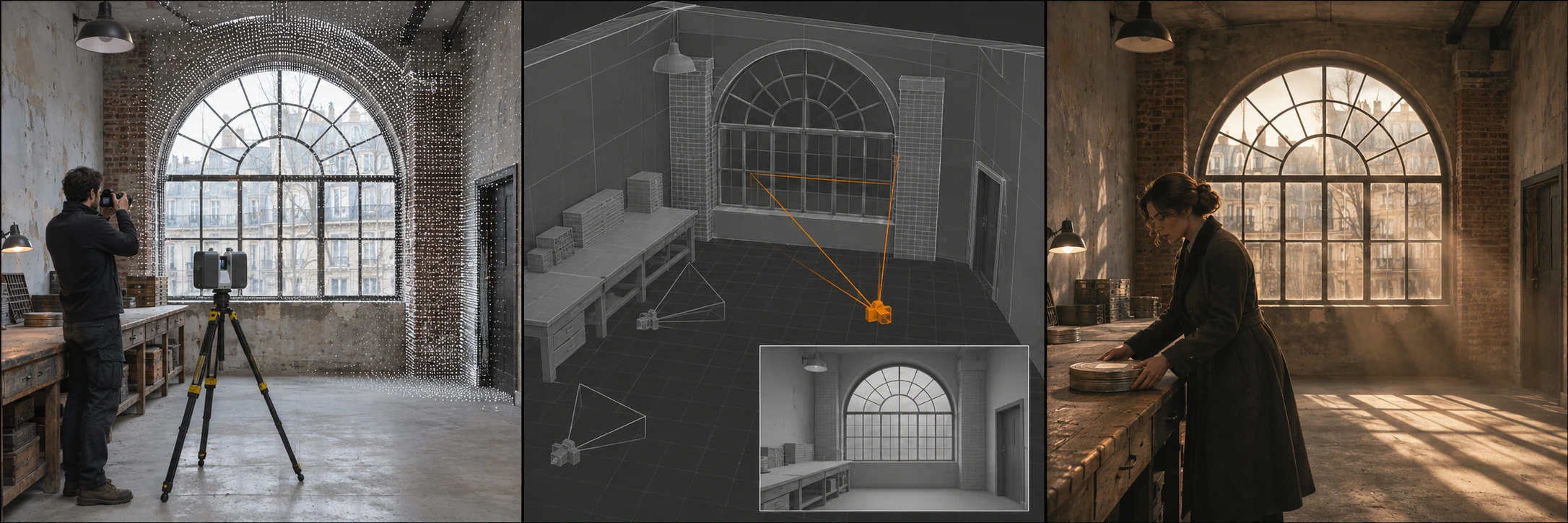
We photograph the location from multiple angles with overlapping shots, or capture its geometry with a LiDAR scan. Photogrammetry reconstructs the space from the photos. The two methods can complement each other.
-
Test camera angles in Blender
In the reconstructed set, we test camera angles, lenses, and moves. We choose the framing that serves the scene, from the wide shot to the reverse angle.
-
Stage the shot with AI
We use the framing chosen in Blender to place the characters or object in the set. AI helps shape the period, materials, and lighting. We check scale, perspective, and lighting for continuity between shots.
05 / Studio
From the set to AI-generated imagery.
The studio combines live-action production, 3D, and AI to create films and sets.
Define the scope.
Where and how will we make the images? With what crew and on what schedule? At the brief, we agree on scope, resources, timing, and approval milestones. We account for location, availability, and distribution constraints before production starts.
A crew built around the film.
The studio draws on a network of professionals in cinematography, editing, and sound. We bring in the skills each project needs, from live-action production to post-production. A single production contact coordinates the work, budget, and schedule through delivery.
Kairos
02 teasersA near-future political series currently in development at Les Faussaires.
- Film & TV
- Commercials
- Docs
- Previs
- Corporate
- Events
- Virtual Sets
- Stills
- Music Videos
06 / Process
From brief to master.
Some shots are filmed. Others are made.
Approvals follow the production sequence, from the visual direction to finishing.
01 Set the brief
We define intended use, runtime, formats, rights, and which shots we’ll create. Shot complexity, sequence count, and dialogue determine the schedule and estimate.
02 Approve the look
We use test images to approve the world, characters, and lighting. Depending on the project, a DIT with color grading expertise can help establish the look and keep shots consistent.
03 Create and edit
A storyboard sets the structure. The edit sets the pace. Once the visual direction is approved, we create the shots and cut the film. In a 3D + AI workflow, we plan coverage and camera moves in a shared set before generating the shots. We consolidate feedback at agreed milestones, first on the sequence and pacing, then on finishing details.
04 Finish and deliver
Post-production handles color grading, sound, and final renders. We check each version and deliverable against the distribution specs agreed at the brief.
07 / Contact
What film
do you need?
A mood film for a campaign, a set to design, or a film to make. A few lines are enough to start the brief.